Quotes

Be happy....make others happy........

Friday, September 3, 2010

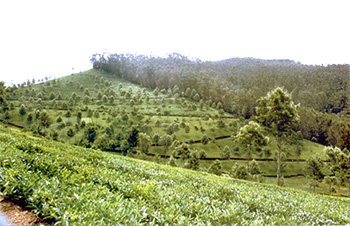
Nilgiris - Fresh Tea


The british have been drinking tea for more than 300 years, today, it accounts for nearly half the fluid intake of a British adult. But can you have a too much of a good thing ?
There is sometimes nothing more reviving than a cup of tea, but in fact it has little nutritional value although the milk or sugar added may supply around 40n calories. However, the stimulant such as caffeine that tea contains can accelerate the heart rate, increase alertness, and help respiration by dilating the airways of the lungs. Asingle cup of tea provides about 40 mg of caffeine, which is almost wtice the amount present in most cola drinks and about
 two thirds the level found in a cup of instant coffee.The tannins in tea are not as useful however. They give it body but can interfere with iron absorption, especially if tea is drunk with iron rich foods. Toddlers should not be given tea because their digestive system are less able to cope with its chemicals stimulant and there is the posibility of developing iron deficiency anemia. Tanins can also stain teeth, particularly dental work. Mouthwashes which contains chlorhexidine should not be used immediately prior to drinking tea because the chemical can accentuate the staining effect.

Tea also contain considerable levels of quercetin, one of the many naturally occuring chemical compounds thatare known as bioflavonoids. Although preliminary research indicates that quercetin might be involved in causing cancer, more recent work suggests that high intakes of bioflavonoids, which are strong antioxidants, are associated with a decreased risk of cancer and heart disease.In particular,green tea and Oolong are thought to have specific anti cancer properties. However, there is still conflicting evidence and the encouraging results of the laboratory experiments have not yet been replicated in population studies. Other constituents of the besides added flavourings such as bergamot, include fluoride (0.25 mg in a cup) and manganese (0.5 mg per cup).
people suffering from peptic ulcer should avoid strong black tea because, light coffee,it stimulates acidic, gastric,seretion and may cause irritation; insted, they should drink weak tea with milk. Tea as also been known to precipitate MIGRAINE in sensitive individuals; it is not known, however, whether this is due to its bioflavonoid or its caffeine content.

Nilgiris - Mountain Railway - Up in the Hills

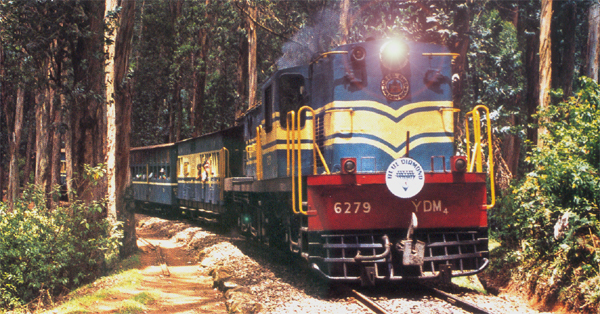
The charming Nilgiri Hill Railway, blue and cream with wooden coaches and large windows, is widely regarded as a marvel of engineering.


At the height of 2,600m stands Udhagamandalam (Ooty) The Queen of Hill Stations. The ‘Nilgiris toy train’ connect Ooty to mettupalayam, at the foot of the Nilgiris.
The construction of this line was a big challenge as the terrain is rather tricky. It was in 1854 that the first plans were drawn to build a mountain railway from mettupalayam to the Nilgiri Hills. But it was a good 45 years later in 1899 that the first train chugged up this track. This railway is widely regarded as a marvel of engineering. The train itself is a charming blue and cream with wooden coaches and large windows. It is hauled up hills by stream engines, designed and built by the Swiss Locomotive Works. Twelve of such locomotive engines survive even today.
The train covers the 46 km to Udhagamandalam in four and a half hours. There are five stations between Mettupalayam and Coonoor - Kallar, Adderley, Hill Grove, Runnymede and Kateri – and, at one time, there were five between Coonoor and Ooty too. Through Wellington, Aruvankadul, Ketti, and Lovedale are still functional, Fren Hill, the last one, was closed down a few years ago.
Good to Know
  • The train, for obvious safety reasons, averages 10.4 km per hour and is perhaps the slowest in India.
  • Built in the late 19th century, the track rises at a gradient of 1 in 12 and has 208 curves and 13 tunnels.
  • It leaves Mettupalayam at 7.45 am and reaches Ooty at noon.
Extensive rice fields surround the 7 km stretch between Mettupalayam and Kallar. Soon after is an impressive 21km section through truly rocky terrain. The track passes over 26 viaducts, and twist and blends through 13 tunnels. After a steep climb, the train enters Coonoor, the little hill station known for its tea plantations. From here, the track is uphill till you reach Fern Hill at a height of 2,218m, the highest point on the railroad. Shortly before Ooty, the line dips downhill. If you enjoy taking pictures, keep your camera ready for a few shotsof the viaduct between Kallar and Adderley. This ride is sure to turn the most hardened rail critic into an avid fan. You’ii delight in hthe edge-of-the seat twists and turns as the train runs across tall girder bridges, and over green hills before gently meandering through rolling tea estates. The exhaust beat of the loco never falters, maintaining a deafening staccato which can be heard for miles around. Truly a journey to remember.
This rail system is unique because it uses the Alternate Biting System (ABT) or the rack and pinion system. A special toothed-rack rail is mounted on the sleepers between the running rails. The train is fitted with cog wheels, that mesh with the rack rail. From Coonoor to Udhagamanadalam, it runs on a non-rack system.

Normally when we travel by train we see the engine in the front. But in the NMR don't be surprised to see the engine at the tail end when climbing. This is because it has to push the train up. And while descending the engine is in front making sure that the train comes down gradually.
The maximum speed of the train is 33-km per hour. It traverses 16 tunnels, 26 bridges, with one big viaduct over the Bhavani. These are indeed feats of engineering, as they merge with Nature — never incongruous, never unattractive.

Queen of hills

Ooty or Udagamandalam (the Tamil version of the original name) rightly described as "Queen of Hill Stations" by Pandit Jawaharlal Nehru, now sprawls over an area of 36 sq km with a number of tall buildings cluttering its hill slopes. It is situated at an altitude of 2,240 meters above sea level. Ooty still woos people from all over India as well as foreign countries right through summer, and sometimes in the winter months too. An added attraction for the tourists to Udagamandalam is the mountain train journey on a ratchet and pinion track which commences from Kallar, near Mettupalayam and wends its way through many hair-raising curves and fearful tunnels and chugs along beside deep ravines full of verdant vegetation, gurgling streams and tea gardens.

The scenery, as it unfolds during the trip, is breathtaking, awe-inspiring and fantastic. One can notice a marvellous change in vegetation, as one goes from Kallar to Coonoor. At Kallar it is tropical and at Burliar-the next bus-stop as one proceeds from Mettupalayam-it is sub-tropical. Near Coonoor, it is humid with pines, blue gum (Eucalyptus globulus) and cypress trees. As we go from Ooty to Gudalur, the change in vegetation is striking. What a splendid interaction between climate and vegetation ! It is therefore very appropriate that Mount Stuart called the whole road leading to Ooty from Mettupalayam, "One long botanical debauch." 


This beautiful botanical paradise was first brought to the public eye by John Sullivan, Collector of Coimbatore district in 1819. But prior to this in 1812, the first Englishmen who were sent up the Nilgris by the Collector of Coimbatore, were Mr. Keys, Assistant Revenue Surveyor, and his Assistant, McMahon. They made their way via Dananayakan Kottai to Aracad and the existing village of Denad, and penetrated as far as Kallatti, the lower level of North Ooty, but never set their eyes on the beautiful valley in which Ooty lay. After Keys' visit there was no further expedition until 1818 when J.C.Whish and N.W.Kindersly (Asst. and second Asst. to the Collector of Coimbatore respectively) went up by the Dananayakan Kottai-Denad route, crossed the plateau in a south-western direction and descended by the Sundapatti pass from Manjakombai to the Bhavani valley and then went back to Coimbatore. The purpose of their visit is not known.

In March 1819, John Sullivan obtained Rs 1,100 (Rupees of those days not to be compared with the present-day rupee) from the Board of Revenue for laying a bridle path up the hill from Sirumugai to Kotagiri and its neighboring village, Dhimatti. The work was executed by McPherson in a period of 2 years starting 1821. This was the only route to the Nilgris from Coimbatore until 1832, when the first Coonoor ghat road was laid, thanks to the then Governor, S.R. Lushington, who got the work executed by Lehardy and Capt. Murray. The present metalled ghat road from Kallar to Coonoor, a distance of 25 km which has 14 hair-pin bends and a gradient of one 18 ft, which facilitated carriage traffic from Madras to Ooty, was mainly constructed by Colonel G.V. Law in 1871. It is gratifying to note that the cascade of the Coonoor river near Wenlock bridge on the Coonoor-Mettupalayam road named after Law, continues to bear the same name.

The Coonoor-Mettupalayam road was extended to Udagamandalam, covering a distance of about 15 km. The Kotagiri-Mettupalayam road (about 34 km long) which was 8 ft wide to begin with, was widened to 17 ft in 1872-75 with a gradient of one in 17 by the Dist. Engineer, Major Morant R.E. and handed over to the District Board in 1881. During the period from 1819 to 1830, John Sullivan's contribution was, apart from laying the route to Ooty, that he built the first house called Stone House in this place. This formed the nucleus of Government offices. Further, at his own expense, he conducted experiments on agricultural and horticultural crops and in animal husbandry to find the most suitable crops and breeds of milch animals for future settlers.Next to the magnificent task of laying the road to Ooty, the British took up, around 1880, the stupendous task of connecting Mettupalayam to Ooty by rail. A Swiss engineer, M. Riggenback and Major Morant of Kotagiri road fame prepared an estimate of 1,32,000 pounds (currency) for laying the rack railway and floated a company called The Rigi Railway & Co Ltd. Since capital was not forthcoming, Mr. Richard Wolley of Coonoor came forward to advance money on the condition that the contract would be entrusted to Mr. Wolley by the Government of Chennai.

The agreement between the 2 was signed in 1886, and the company called The Nilgri Railway & Company came into being with a capital of Rs 25 lakhs. The work on the line was started in August 1891 by Lord Wenlock, Governor or Madras, but the company was liquidated in 1894. Later, a new company was formed in 1894, and the work was completed in 1899. The line was worked by Madras Railway, to start with. Though the Nilgris formed part of Coimbatore district, it was separated into an independent district in 1868. For a period of 13 years from 1830, it remained part of Malabar district. This was to prevent tobacco smuggling from Coimbatore. From John Sullivan's days to this date, more than 170 years have rolled by. Udagamandalam considered a sanatorium and hill resort by the Europeans, has come to be like any other district. The devastation was so much that a ban on fresh construction was belatedly imposed by the Government. 
And finally the common wealth games problem includes ARR too......


AR Rahman's anthem for the Commonwealth Games hasn't gone down well with both fans and politicians. While the song's online popularity is nowhere near that of Shakira's " Waka Waka", which he famously claimed his tune would surpass, politicians and Games officials now want the 5 crore-track "recomposed".

"Swagatham" aka "Jiyo Utho Heyo" which critics say has neither the pace nor the punch of "Waka Waka", or the rousing quality of "Maa Tujhe Salaam", has disappointed. Ever since he posted links to the tracks on his social networking pages, Rahman has been flooded with unsavoury comments. The games committee's unhappy too. Vijaykumar Malhotra, board member of the organising committee (OC) claimed, "We expected a better song from Rahman." Former sports minister Shahnawaz Hussain said, "I respect Rahman for what he has achieved but the track simply does not excite me. No one in the OC likes it except perhaps Suresh Kalmadi." Hussain demanded a re-composition after Lalit Bhanot, organising secretary of the games, insisted that people would begin liking "Swagatham" if they keep listening to it. "Either it's good music or bad. There's no middle way to evaluate the appeal of a 5 crore track, he can surely re-compose it," he said.

Thursday, September 2, 2010

Really funny people

People cut down the trees and make paper  and write SAVE TREES .......
Coimbatore (Kovai for short) is the second largest city / Metro in Tamil Nadu. A city with 1.5 million population, it is also one of the faster growing cities in TN. The name Coimbatore always conjures up images of textile mills and industries in my mind. It is also one city that looks urban/cityish after Chennai in TN. It is not a city assosciated much with Tamil / Tamilnadu (Politically). Inspite of it being the second most important city economically and commercially, it is a relatively political lightweight, maybe because it is situated in one corner of TN.

Unlike Madurai, Trichy or Thanjavur, Kovai does not have much history behind it. It is a relatively new city which came into prominence because of the entrepreneurial nature of its citizens ably helped by the various hydel power projects in neighboring Nilgiris district. Kovai is the centre for Textile and textile machinery, foundries, auto components,wet grinders, pumps and many small scale engineering units. The industrial output from Coimbatore is said to be over 10,000 crores* annually. Much, if not all of this development should be attributed to the local people and a few visionaries as this growth was achieved purely by the them with very little governmental support (in terms of PSU or institutions) or any large scale factory.

Kovai is also poised to enter the IT map as a second tier city in TN. With a pleasant climate and a huge manpower availability in its catchment area, it has everything going for it to become a major player in IT. Unfortunately so far, there's been no real catalyst for growth here. Recently CTS has entered the city in a small way with TCS and Wipro likely to join soon. Hopefully, this will kickstart the industry here and help Kovai retains its second place in TN economy.

Kovai is also an affluent place. It matches Chennai per capita in consumtion of most consumer items including luxury cars and cellphones. The real estate costs are highest after Chennai. Coimbatore was talked of as the next Pune/Hyderabad in the early nineties, but for the serial bomb blasts, it might have happened. That incident pushed the growth down, affected the morale and subdued this growing city. It has largely returned to normal and just needs a spark to come back to the growth trajectory. IMHO, an IT park like Tidel is what the city needs now.

There's not much for a tourist in the city. It just acts as a wayside stop for the tourists going towards Ooty, Valpari etc. A couple of temples - Perur and Maruthamalai are the major highlights here, but the city is sorrounded by a lot of important tourist spots that can be reached in an hour or two. Ooty (Nilgiris), Valparai, as mentioned earlier, APA, Siruvani and Malampuzha dams, IndiraGandhi WIld life sanctuary, Black Thunder water park are some the more famous ones.